In this article
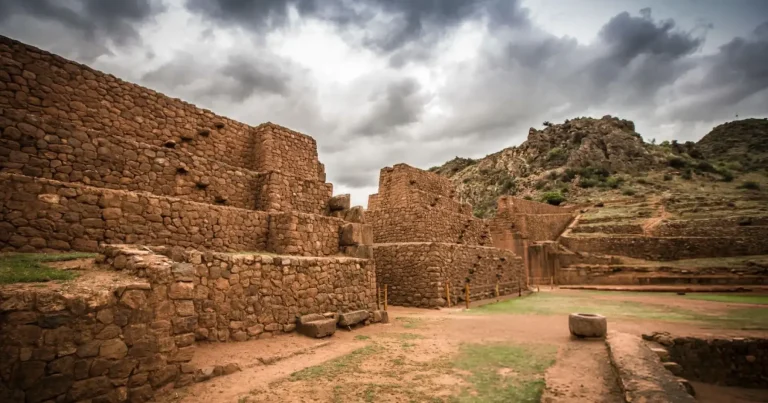
Sacsayhuamán (also written Saqsaywaman) is the great Inca complex on the hill above Cusco, famous for its zigzag walls of stones weighing many tons. It is about 2 km from the Plaza de Armas, sits at around 3,600 m and is the stage of the Inti Raymi every 24 June. This guide covers tickets, opening hours, what to see, how to get there and the history — with data from Peru’s Ministry of Culture.
Sources: Decentralized Directorate of Culture of Cusco, Sacsayhuamán Archaeological Park Master Plan 2024–2030, COSITUC (Cusco Tourist Ticket) and UNESCO. Checked on 5 October 2026.
Key facts
| What | Details |
|---|---|
| Altitude | About 3,590 m at the great walls and 3,607 m at the Rodadero — some 200 m above the Plaza de Armas |
| Distance | About 2 km north-east of the Plaza de Armas |
| Opening hours | Every day, 7:00 a.m. – 5:30 p.m. |
| Ticket | Cusco Tourist Ticket: partial Circuit I (S/ 70) or full ticket (S/ 130) for foreign visitors |
| Archaeological park | 2,997 hectares with 96 archaeological sites |
| Time needed | 1 h 30 min – 2 h for the main area; half a day for the whole Circuit I |
Tickets: the Cusco Tourist Ticket
There is no single ticket for Sacsayhuamán: you enter with the Cusco Tourist Ticket (Boleto Turístico del Cusco, BTC), sold by COSITUC. Official prices:
| Ticket | Price | Valid | Sites |
|---|---|---|---|
| Partial Circuit I — foreign visitors | S/ 70 | 5 days | Sacsayhuamán, Q’enqo, Puka Pukara, Tambomachay |
| Full ticket — foreign visitors | S/ 130 | 10 days | 16 sites in Cusco, the Sacred Valley and the South Valley |
| Full ticket — foreign students (with a valid student card) | S/ 70 | 10 days | 16 sites |
| Partial Circuit I — Peruvians | S/ 40 | 1 day | Circuit I |
| Full ticket — Peruvians | S/ 70 | 10 days | 16 sites |
- Where to buy: in person only, at the COSITUC office (Av. El Sol 103, Galerías Turísticas, 7:30 a.m.–6:00 p.m.) or at the ticket booths of the sites. It is not sold online. Bring soles in cash.
- Children under 9 enter free. Student rates apply to ages 10–17 with an ID and 18–25 with a university or ISIC card.
- Which one? If you will also visit the Sacred Valley (Pisac, Ollantaytambo, Moray, Chinchero) or the South Valley, the full ticket is better value.
- Changes coming: a new Tourist Ticket law (Law 32586) was published in May 2026. It allows single-site tickets and a digital ticket; its regulation was published for public comment in October 2026. Current prices stay in force until then.
What to see at Sacsayhuamán
- The great walls: three terraces of retaining walls in zigzag, facing the Chuquipampa esplanade. The stones of the first wall are 3–5 m high and weigh 90–125 tonnes, according to the Ministry of Culture; estimates for the largest block range from about 128 to 360 tonnes, depending on the author.
- Muyuqmarka: on the upper platform, the foundations of a large circular structure and two rectangular ones — the towers described by the chroniclers.
- Suchuna (the Rodadero) and the “Inca’s throne”: a diorite outcrop polished into wave-like slides, with a carved stepped seat facing south-east.
- The Chincanas: the Chincana Chica, a narrow 20 m passage through the rock, and the Chincana Grande, with carvings and terraces.
- Qhapaq Qocha: a large circular reservoir with channels north of the esplanade.
Circuit I: Q’enqo, Puka Pukara and Tambomachay
The partial ticket also covers three sites along the road to Pisac, which most visitors see in the same half day:
- Q’enqo (3,603 m): a carved limestone outcrop with a ritual chamber and zigzag channels, 1.2 km from the walls in a straight line.
- Puka Pukara (3,786 m): a checkpoint and lodging on the Inca road to the Antisuyu.
- Tambomachay (3,805 m): the “Inca baths”, with water still running through Inca channels, 0.7 km from Puka Pukara.
Our Cusco City Tour visits all four sites and the Qorikancha in half a day, with transport and a bilingual guide, from USD 15.
How to get to Sacsayhuamán
- On foot: from the Plaza de Armas, walk up through the San Cristóbal neighborhood or through San Blas. It is a steep climb at altitude: allow 25–40 minutes.
- By taxi: taxis take the Circunvalación road to the park entrance on the road to Pisac.
- On a tour: the City Tour includes transport between the four sites, which are spread over several kilometers.
History in brief
- Who built it: according to the Ministry of Culture, the work began under the ninth Inca, Pachacútec, and continued under Túpac Inca Yupanqui, Huayna Cápac and Huáscar. It was called the House of the Sun of Hanan Qosqo, the upper half of the city.
- The name: usually explained as “satiated falcon” (from Quechua saqsay, full, and waman, falcon). The idea that it forms the head of a puma-shaped Cusco is a popular theory.
- 1536: during the siege of Cusco, Manco Inca’s forces held Sacsayhuamán. Juan Pizarro was hit by a stone in the attack and died days later; the Spanish took the towers at night with ladders.
- A quarry for Cusco: after the conquest, many stones were taken to build churches and mansions in the city, which is why mainly the huge lower blocks remain.
- UNESCO: the City of Cusco has been a World Heritage Site since 1983. Sacsayhuamán is right next to it, although outside the inscribed area of the historic center.
Inti Raymi at Sacsayhuamán
Every 24 June, the Inti Raymi, the Inca Festival of the Sun, ends with its main ceremony on the Sacsayhuamán esplanade (at 1:00 p.m. in 2026, after Qorikancha and the Plaza de Armas). In 2026 the seated stands cost S/ 490–850 and sold out. You can watch for free from the Suchuna and Cruz del Papa areas, while other sectors are closed. Read our Inti Raymi guide.
Tips for your visit
- Go early, when the site opens at 7:00 a.m., or in the late afternoon for softer light.
- Do not climb on the walls or the carved rocks; drones, food and alcohol are not allowed.
- In the rainy season (November–March) electric storms are common: leave open areas if you hear thunder.
- The ground is uneven grass and stone. Wear shoes with grip, and bring water and sun protection.
- Walk up in daylight and in company, and keep your ticket and ID with you.
Frequently asked questions
How much does it cost to enter Sacsayhuamán?
Foreign visitors need the Cusco Tourist Ticket: the partial Circuit I ticket costs S/ 70 (valid 5 days) and the full ticket S/ 130 (valid 10 days). Peruvians pay S/ 40 for Circuit I.
Can I buy the Sacsayhuamán ticket online?
No. It is sold in person only, at the COSITUC office on Av. El Sol 103 or at the site ticket booths. Bring soles in cash.
What are Sacsayhuamán’s opening hours?
Every day from 7:00 a.m. to 5:30 p.m.
How long do I need at Sacsayhuamán?
About 1 h 30 min to 2 hours for the walls, the Rodadero and the Chincanas, and half a day if you add Q’enqo, Puka Pukara and Tambomachay.
Can I walk to Sacsayhuamán from the Plaza de Armas?
Yes. It is about 2 km uphill through San Cristóbal or San Blas; allow 25–40 minutes and take it slowly if you have just arrived in Cusco.
How high is Sacsayhuamán?
About 3,590 m at the great walls, around 200 m higher than the Plaza de Armas.
Is Sacsayhuamán the same as Saqsaywaman?
Yes. Saqsaywaman is the spelling used by the Ministry of Culture; Sacsayhuamán, Saqsayhuaman and Sacsahuamán refer to the same site.
Is Sacsayhuamán a UNESCO World Heritage Site?
The City of Cusco is a World Heritage Site since 1983. Sacsayhuamán is next to it but outside the inscribed historic center.