In this article
- Is the Choquequirao cable car open?
- Current status of the project (2026)
- Timeline of the project, newest first
- When will the Choquequirao cable car be finished?
- How would the cable car work?
- What it would change for visitors
- What it means for your trip in 2026 and 2027
- How to visit Choquequirao now
- Frequently asked questions
Quick answer: there is no cable car to Choquequirao yet. The project, with a total concession cost of about USD 442 million, is still in the tender stage: ProInversión expects to award it in late 2026, with construction starting in 2027 at the earliest. Until it is built, which will take several years, the only way to reach Choquequirao is on foot, on a trek of at least 3 to 4 days.
Is the Choquequirao cable car open?
No. As of 2026 there is no cable car, no construction and no opening date. You may find old articles with opening dates that were never met. The project has been announced several times since 2011 and redesigned more than once.
Current status of the project (2026)
- Total cost: about USD 442 million for the whole concession (USD 441.57 million), according to the newspaper Gestión (April 2026). Earlier figures spoke of USD 261 million of investment.
- Model: a public-private partnership (APP) promoted by ProInversión, Peru’s private investment agency.
- Tender: five national and international bidders were prequalified in April 2026.
- Award: expected between October and November 2026, after earlier targets in the first half of the year were postponed.
- Construction: planned to start in 2027 if the award goes ahead.
- Part of a package: Choquequirao belongs to a package of six cable car projects worth about USD 703 million, to be awarded as public-private partnerships by around 2028, according to Gestión. Its result is expected to set the course for the other five.
Timeline of the project, newest first
These are the milestones we could confirm in official statements and the Peruvian press. Many earlier dates were not met.
- April 2026: five bidders have acquired the right to take part in the tender. Gestión reports a total concession cost of USD 441.57 million and an award expected in the last quarter of 2026.
- July and October 2025: ProInversión moves the award target to the first quarter of 2026, and then to before July 2026. Neither date was met.
- 28 March 2025: ProInversión calls a national and international public tender, with an estimated investment of USD 261 million and an award planned for the last quarter of 2025. The design has two cable car lines: one from Huanipaca, in Apurímac, and one from Yanama, in Cusco.
- February 2024: ProInversión adds the redesigned project to its investment promotion process, with a reference investment of USD 220 million.
- August 2020: ProInversión announces a redesign, from one cable system to two.
- May 2017: the award of the concession is cancelled.
- 2014: a tender is called, and in May the prime minister announces that construction will begin by the end of that year. It did not.
- 2013: the government launches a national cable car program with Choquequirao as its first project, at about USD 48 million, and the Housing Ministry asks ProInversión to take it on.
- August 2011: the regional president of Apurímac announces the idea of a cable car to Choquequirao.
When will the Choquequirao cable car be finished?
There is no official completion date. Construction of a cable car across one of the deepest canyons in the Andes takes several years, so even if the schedule holds, it is unlikely to carry visitors before the end of the decade. Given the history of delays, we recommend not planning a trip around it.
How would the cable car work?
The plan is to cross the Apurímac canyon from the Kiuñalla area, on the Apurímac side, up to the archaeological site. The trip would take around 15 to 20 minutes, instead of the two days of hiking needed today. The final design, capacity and ticket price will depend on the company that wins the concession.
Since the 2020 redesign the project includes a second line from Yanama, on the Cusco side of the site, with about 10.6 km of cable in total, according to ProInversión figures reported by Gestión. Official projections speak of more than one million visitors a year, compared with about 8,000 to 9,000 today.
What it would change for visitors
- Easier access: visitors who cannot do a hard trek could see Choquequirao in a day trip.
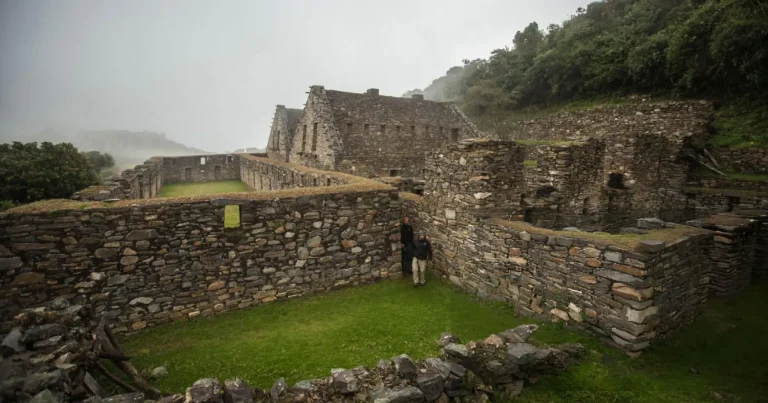
- More visitors: the site, which receives only a few dozen people a day today, would become a mass destination like Machu Picchu.
- Local economy: communities in Cusco and Apurímac expect new jobs and services, while archaeologists ask for controls to protect the site.
In other words, the quiet Choquequirao that trekkers enjoy today may not last. If you want to see it almost empty, now is the time.
What it means for your trip in 2026 and 2027
- Plan to hike: any trip in 2026 or 2027 means trekking. Even with an award in late 2026, the cable car will not be running during that time.
- No tickets exist: since the cable car has not been built, there are no cable car tickets or cable car tours to Choquequirao. Any offer that includes one is wrong.
- The trek is unaffected: the tender does not change the route from Cachora and Capuliyoc, or the entrance at the control point.
- Watch the season instead: the weather matters more than the cable car. In 2026 the park was closed because of heavy rain from 1 February to late April (it reopened around 22–23 April). Go between May and October.
How to visit Choquequirao now
The classic route is the trek from Capuliyoc, above the village of Cachora, about 4 hours by road from Cusco. In four days you descend into the Apurímac canyon, climb to the ruins, visit them with a guide and return the same way. It is a demanding trek, with mules for the camping equipment and a cook.
- 39 kmhiking distance (24.2 mi)
- 3,064 mhighest point: Choquequirao (10,052 ft)
- +2,882 melevation gain from Capuliyoc
- km 0 Capuliyoc Start · view over the Apurímac canyon
- km 7 Chiquisca
- km 9 Playa Rosalina Camp 1 · Apurímac river
- km 12 Santa Rosa
- km 15.5 Marampata First view of Choquequirao
- km 19.5 Choquequirao Camp 2 · guided visit on day 3
- km 29.5 Playa Rosalina (return) Cross the Apurímac again
- km 32 Chiquisca (return) Camp 3
- km 39 Capuliyoc (end) Transport back to Cusco
Read our complete Choquequirao trek guide for the route, the difficulty and what to pack, and how to get to Choquequirao for all the access options. If you are still choosing between the two great Inca sites, see Choquequirao vs Machu Picchu.
 Visit Choquequirao before the cable car
Choquequirao Trek 4 Days / 3 Nights
See itinerary & dates →
Visit Choquequirao before the cable car
Choquequirao Trek 4 Days / 3 Nights
See itinerary & dates →
Frequently asked questions
Is there a cable car to Choquequirao?
Not yet. The cable car is a project in the tender stage; there is no construction yet.
When will the Choquequirao cable car open?
There is no official date. The award is expected in late 2026 and construction would start in 2027 at the earliest, so it is unlikely to open before the end of the decade.
How much will the Choquequirao cable car cost?
The total cost of the concession is estimated at about USD 442 million (earlier figures spoke of USD 261 million of investment). The ticket price for visitors has not been announced.
Can I visit Choquequirao in one day without the cable car?
No. Without a cable car or road, the minimum is a very demanding 3-day trek; we recommend 4 days.
Who will build the Choquequirao cable car?
No company has been chosen yet. Five national and international bidders are in the tender run by ProInversión, and the winner is expected to be announced in the last quarter of 2026.
Where will the cable car start?
The current design has two lines: one from the Huanipaca and Kiuñalla area, in Apurímac, and one from Yanama, on the Cusco side. The exact location of the stations will depend on the final design.
How long will the cable car ride take?
About 20 minutes according to official estimates, instead of the two days of hiking each way needed today.
Why has the project taken so long?
It was first announced in 2011, the concession award was cancelled in 2017, the design changed in 2020, and award dates in 2025 and 2026 were moved. In 2026 investors still had concerns about risk sharing, payments and land acquisition.
Should I wait for the cable car to visit Choquequirao?
Only if you cannot hike for several days. Otherwise, go now: today you can see the site with very few people, which is unlikely once the cable car is running.